Every July 6th, Pamplona is transformed. For nine days, the whole city moves to the rhythm of the running of the bulls, live music and the red neckerchief. Beyond the party, San Fermín is a full immersion in Spanish — with all its intensity, its humour and its very own vocabulary. Cada 6 de julio, Pamplona se transforma. Durante nueve días, la ciudad entera vive al ritmo de los encierros, la música y el pañuelo rojo. Pero más allá de la fiesta, San Fermín es una inmersión total en español — con toda su intensidad, su humor y su vocabulario propio.

San Fermín has its roots in religious devotion to the patron saint of Navarre, combined with the old cattle fairs held in Pamplona. The chupinazo — the rocket launched on July 6th at 12:00 from the balcony of the town hall — marks the official start. From that moment on, the city barely sleeps for over a week. San Fermín tiene su origen en la devoción religiosa al patrón de Navarra, combinada con las antiguas ferias ganaderas de Pamplona. El chupinazo —el cohete que se lanza el 6 de julio a las 12:00 desde el balcón del ayuntamiento— marca el inicio oficial. A partir de ahí, la ciudad apenas duerme durante más de una semana.
Unlike Easter, which shifts every year, San Fermín always falls on the same dates: July 6th to 14th, whatever the day of the week. The evening before the chupinazo, tradition brings the riau-riau — a slow, chaotic procession in which the city council tries (and, for decades, has failed) to walk the few metres from the town hall to the church of San Lorenzo, swallowed up by a crowd that has no intention of letting them arrive on time. It's chaotic, noisy, and utterly Pamplonese. A diferencia de la Semana Santa, que cambia cada año, San Fermín cae siempre en las mismas fechas: del 6 al 14 de julio, caiga en el día de la semana que caiga. La tarde anterior al chupinazo, la tradición trae el riau-riau — un desfile lento y caótico en el que la corporación municipal intenta (y, desde hace décadas, no consigue) recorrer los pocos metros que separan el ayuntamiento de la iglesia de San Lorenzo, engullida por una multitud que no tiene ninguna intención de dejarles llegar a tiempo. Es caótico, ruidoso y absolutamente pamplonica.
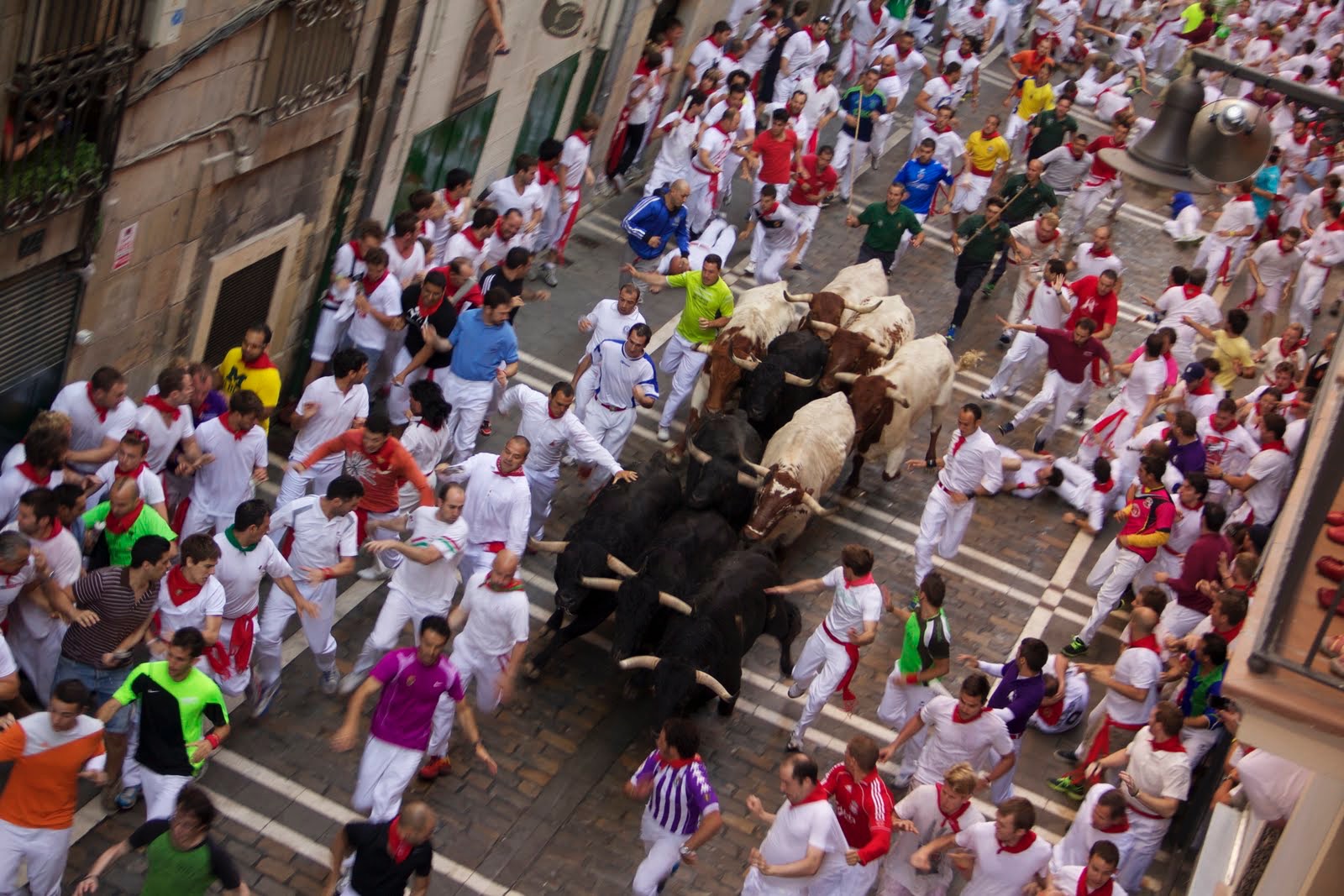
Every morning at 8:00, a group of bulls runs through the streets of the old town alongside the mozos (the runners), in a route of 848 metres — from the corrals of Santo Domingo to the bullring — that lasts barely two or three minutes but carries maximum tension. Runners wear the traditional white outfit with the red neckerchief around their neck, and the Red Cross keeps a permanent presence along the route, ready to treat the dozens of injuries — mostly from falls, not horn wounds — that happen every year. Cada mañana a las 8:00, un grupo de toros recorre las calles del casco antiguo junto a los mozos (los corredores), en un trayecto de 848 metros —desde los corrales de Santo Domingo hasta la plaza de toros— que dura apenas dos o tres minutos pero de máxima tensión. Los corredores llevan la ropa blanca tradicional con el pañuelo rojo al cuello, y la Cruz Roja mantiene una presencia permanente a lo largo del recorrido, lista para atender las decenas de heridos —la mayoría por caídas, no por cornadas— que se producen cada año.
In the afternoon, at 18:30, the day's bulls reappear in the corrida (the bullfight) — a tradition that divides opinion even among Spaniards, and one that's worth knowing about even if you choose not to attend. Por la tarde, a las 18:30, los toros del día reaparecen en la corrida —una tradición que divide opiniones incluso entre los propios españoles, y que conviene conocer aunque decidas no asistir.
American writer Ernest Hemingway discovered San Fermín in 1923 and was so captivated that he kept coming back, year after year. In 1926 he published Fiesta (The Sun Also Rises), the novel that turned the running of the bulls in Pamplona into an international myth. For Hemingway, the festival represented an intense, authentic way of living — the exact opposite of the lost generation he portrayed in his books. El escritor estadounidense Ernest Hemingway descubrió San Fermín en 1923 y quedó tan fascinado que volvió año tras año. En 1926 publicó Fiesta (The Sun Also Rises), la novela que convirtió los encierros de Pamplona en un mito internacional. Para Hemingway, la fiesta representaba una forma de vida intensa y auténtica — todo lo contrario a la generación perdida que retrataba en sus libros.
Pamplona has not forgotten that bond: there is a statue of him facing the bullring, and one of the best-known streets of the Feria del Toro bears his name (Paseo Hemingway). Every year, many American visitors arrive at San Fermín following his literary footsteps, chasing the same emotion he described almost a century ago. Pamplona no olvida ese vínculo: hay una estatua suya frente a la plaza de toros, y una de las calles más conocidas de la Feria del Toro lleva su nombre (Paseo Hemingway). Cada año, muchos turistas americanos llegan a San Fermín siguiendo sus pasos literarios, buscando la misma emoción que él describió hace casi un siglo.
"Nobody goes to bed in Pamplona during San Fermín."
Ernest Hemingway — still just as true todayErnest Hemingway — algo que hoy en día sigue siendo completamente cierto"¿Vas a correr el encierro este año?" (Are you going to run with the bulls this year?) "¿Vas a correr el encierro este año?" (¿Vas a participar corriendo delante de los toros?)
It's a common question between locals from Pamplona and visitors, and a great way to understand the verb "correr" used in a context very different from playing sport. Es una pregunta habitual entre pamplonicas y visitantes, y una buena forma de entender el uso del verbo "correr" en un contexto muy distinto al de hacer deporte.
San Fermín is also the dianas — the brass bands that walk through the streets from early morning, waking up a city that barely went to sleep — and the gigantes y cabezudos, the giant papier-mâché figures representing kings and queens from four continents that parade every afternoon, chased by children trying to touch them. It is endless dinners at the clubhouse of the peña, fireworks every night at 23:00 over the Ciudadela, and sixteen peñas competing to be the loudest, the most creative and the most generous with the wine they pour on total strangers. San Fermín también son las dianas — las charangas que recorren las calles desde primera hora, despertando a una ciudad que apenas ha dormido— y los gigantes y cabezudos, las figuras de cartón piedra que representan a reyes y reinas de cuatro continentes y que desfilan cada tarde, perseguidas por niños que intentan tocarlas. Son las cenas interminables en el local de la peña, los fuegos artificiales cada noche a las 23:00 sobre la Ciudadela, y las dieciséis peñas compitiendo por ser la más ruidosa, la más creativa y la más generosa con el vino que reparte a completos desconocidos.
And then, at midnight on July 14th, everything stops for the Pobre de mí — the song that closes the festival in the Plaza Consistorial, sung by thousands of people holding a lit candle while they take off their red neckerchief. It's an almost melancholic chant that contrasts sharply with the euphoria of the previous nine days: the moment when Pamplona, for a few seconds, falls silent before returning to its everyday rhythm — until next year's chupinazo. Y entonces, a medianoche del 14 de julio, todo se detiene para el Pobre de mí — la canción que cierra las fiestas en la Plaza Consistorial, cantada por miles de personas con una vela encendida mientras se quitan el pañuelo rojo. Es un canto casi melancólico que contrasta con la euforia de los nueve días anteriores: el momento en que Pamplona, durante unos segundos, se queda en silencio antes de volver a su ritmo de cada día — hasta el chupinazo del año que viene.
Article written by Spanish Lessons with MercedesArtículo elaborado por Spanish Lessons with Mercedes